
Scholasticide in Palestine
Education as a site of domination and resistance
“We call upon our colleagues in the homeland and internationally to support our steadfast attempts to defend and preserve our universities for the sake of the future of our people, and our ability to remain on our Palestinian land in Gaza. We built these universities from tents. And from tents, with the support of our friends, we will rebuild them once again.”
- Gaza Academics and Administrators, May 20241
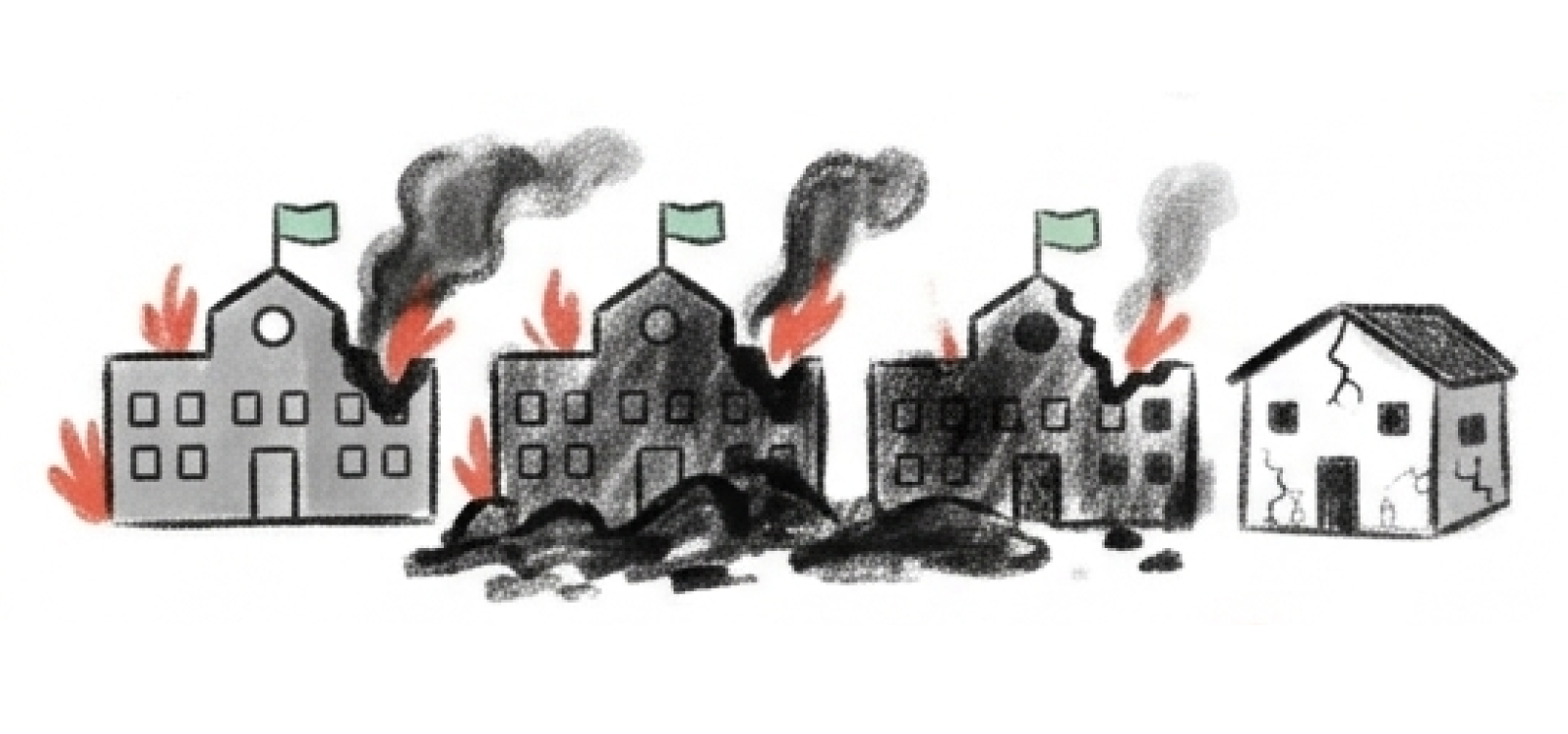
Since October 2023, all of Gaza’s Universities have been carpet bombed along with 97% of schools – these include UN schools sheltering forcibly displaced Palestinians.2 Libraries, archives, educators, and students have been deliberately targeted as part of a broader effort to dismantle the conditions necessary for Palestinian collective life.3
All Universities’ public libraries have been completely destroyed. The Central Archives of Gaza City, containing 150 years of municipal, land, and Ottoman-era records, were also destroyed, erasing historical documentation of Palestinian existence and memory. Of a handful of school buildings left standing, most are now converted into Israeli military positions.
This annihilation of education did not begin with the current genocidal assault on Gaza. It is the culmination of a decades-long policy to systematically target Palestine’s education system, from the Jordan River to the Mediterranean Sea, regionally and internationally.
Scholasticide
Education is a pathway to employment and social mobility. It is also more than that; it is a means of preserving identity, nurturing critical thought, sustaining collective memory, and imagining futures beyond present oppression. Across Palestine and in the shataat (diaspora), Palestinians, as a whole, have been for a long time recognised as among the most highly educated population in the world.4 Education has been and remains a cornerstone of Palestinian resilience: a way of maintaining the connections to land, history, culture, and supporting the quest for national liberation.
This vision of the vital role of education in liberating human beings resonates with the work of Brazilian educator, Paulo Freire. He argued – long ago – that education is never neutral: it either reinforces systems of domination or becomes part of practices of liberation, the striving for freedom.5 Freire understood the purpose of education as leading to conscientization. This means a process that develops a critical consciousness. In this way, education enables people to recognise the political, social, and economic structures that shape their lives. Collectively, education, if it is empowering, can help people to transform these structures.6 In this sense, a Freirian notion of education is not confined to acquiring information; it involves becoming the subjects of history instead of passive objects of oppression.
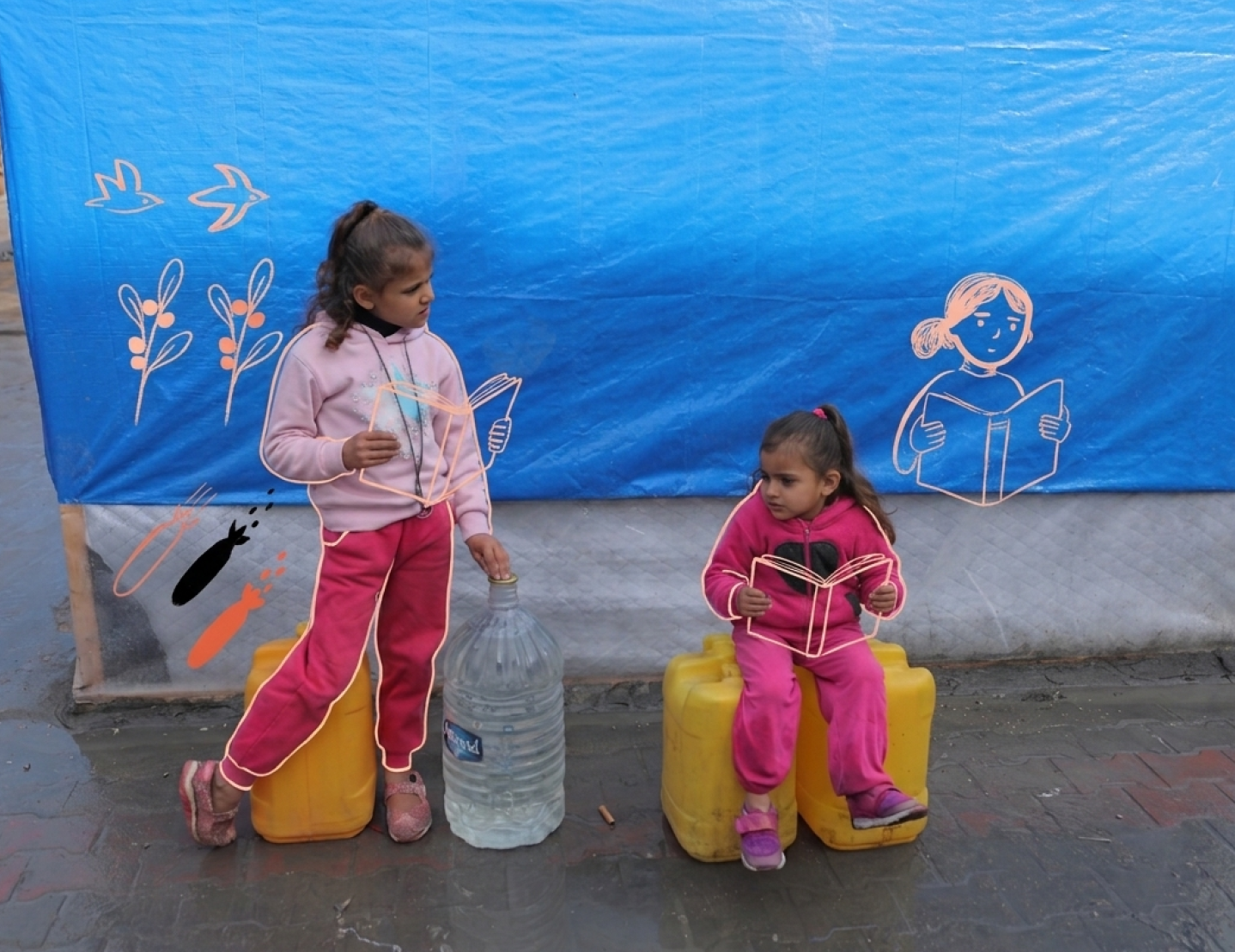
“We, the students of the Gaza Strip, seek hope amidst despair. We only find it in education and learning, despite the numerous difficulties and obstacles we face, like living in a conflict and war zone.”
It is precisely because of its transformative potential that education has been systematically targeted by settler-colonial violence, in Palestine and among Palestinians. This has been described as 'scholasticide', a term coined by Professor Karma Nabulsi in the context of Israel’s assault on Gaza in 2008-09. Scholasticide involves the deliberate destruction of an education system and of the institutions that sustain knowledge, memory, and intellectual life. Its purpose is to undermine a people's capacity to preserve its history, exercise critical thinking, and to imagine a better future in which liberation will be achieved.
The physical destruction of schools and universities in Gaza is part of a much wider attempt to sever the relationship between younger generations of Palestinians, their history, their identity, and their collective aspirations.
The Colonial Playbook
Scholasticide is very much in line with the way colonial powers historically controlled schooling to produce compliant subjects, erase Indigenous histories, and reshape collective identities according to colonial self-interest.8
British and French administrations regulated curricula and language use across their former colonies to reinforce imperial rule. An example was in Algeria, where the French colonial education system consistently marginalized Arabic and privileged French as the only language of instruction and administration. Frantz Fanon showed how this was part of efforts by the French colonisers to weaken Algerian culture and damage the historical identity of the colonised.9
Settler-colonial states such as the United States, Canada, and Australia used education as a tool of genocide, including residential and boarding schools. These institutions severed Indigenous children from their own languages, cultures and families. Such policies sought to destroy Indigenous communities through ‘re-educating’ their children.
Israel's systematic targeting of Palestinian education reflects a similar settler-colonial logic, but is based not on re-education, but on erasure. The destruction witnessed today is not confined to the present period since 2023. It is an intensification of a longstanding pattern of attacks against Palestinian educational institutions, knowledge production, and intellectual life for decades; indeed for more than a century. Across the fragmented geographies of Palestinian territories, education has remained a central site of colonial intervention because it sustains collective memory, identity, and political consciousness.
Scholasticide in Context
The modalities of scholasticide have changed over time and across space, ranging from the appropriation and erasure of knowledge, to the complete destruction of educational infrastructure, restrictions on access to materials, repression and killings of students and educators, and replacement of curricula and historical narratives with those of the colonial settler state. Together, these practices reveal a broader strategy aimed at disrupting the conditions through which Palestinian society has sought to reproduce itself through education, broadly defined.
Not just in Gaza, not just from 2023

Gaza's education system was already vulnerable prior to 2008-2009, after decades of the blockade, and military restrictions on Gazans’ movements. By October 2023, when direct attacks escalated, chronic shortages and restrictions, attacks and the blockade already meant that roughly 70% of UNRWA schools and 63% of government schools in Gaza were operating double or triple shifts for pupils. This, due to chronic overcrowding and poor infrastructure. Military escalation meant more and more schools were forced to close, and Israeli restrictions on electricity supplies and human movement restricted access to alternative forms of learning for both children and adults in Gaza.
In eastern Palestine and Al-Quds (Jerusalem), occupation structures shape everyday experiences of schooling through checkpoints, the IDF military presence, settler violence, permit regimes and repeated searches. For many Palestinian children, reaching school has become an encounter with violence and surveillance. One quarter of Palestinian students report feeling unsafe even once they reach school, and this feeling of insecurity rises to approximately 70% in Nablus.12 One third of Palestinian school children report difficulty concentrating in class, and fear is the primary cause in 80% of those experiencing difficulties in concentrating.13
The situation is expressed by Ali, who is from Tuba in Masafer Yatta. His years of schooling were between 2004 and 2016:
“Why am I different from other people who work, play, learn and love without being constantly targeted by violence? Am I less worthy? Less human? … It is unconscionable that the cost of going to school can mean coming back home with a broken body and losing the whole school year.”
Between 201014 until September 2023, the broader system of Palestinian education outside Gaza has been violently disrupted. The demolition of 11 schools has taken place and demolition orders have been issued against more than 50 more schools. Approximately 300 children and teachers have been arrested and detained, either from school or while travelling to schools. School supplies have been confiscated from 481 students whilst they tried to pass through checkpoints. Since 2010 there have been 1,826 military attacks specifically against schools in the West Bank. In Gaza, 1,434 schools and kindergartens have been completely destroyed since October 2023.
Even in Al-Quds (Jerusalem), bureaucratic mechanisms of control result in the educational exclusion of Palestinian students. Residency and registration restrictions have prevented approximately 13% of Palestinian children in Al-Quds (Jerusalem) from accessing primary or secondary education, undermining their connection to their own communities, and even threatening their continued presence in the city.
In the Naqab, denial of educational infrastructure is part of wider policies affecting Palestinian Bedouin communities. Tens of thousands of children living in unrecognised villages lack access to local schools. Some students are forced to travel long distances, up to 90 kilometres daily, just to attend overcrowded schools. Such restrictions are aimed at displacing remaining Bedouin communities by undermining their ability to remain rooted in their own lands.17
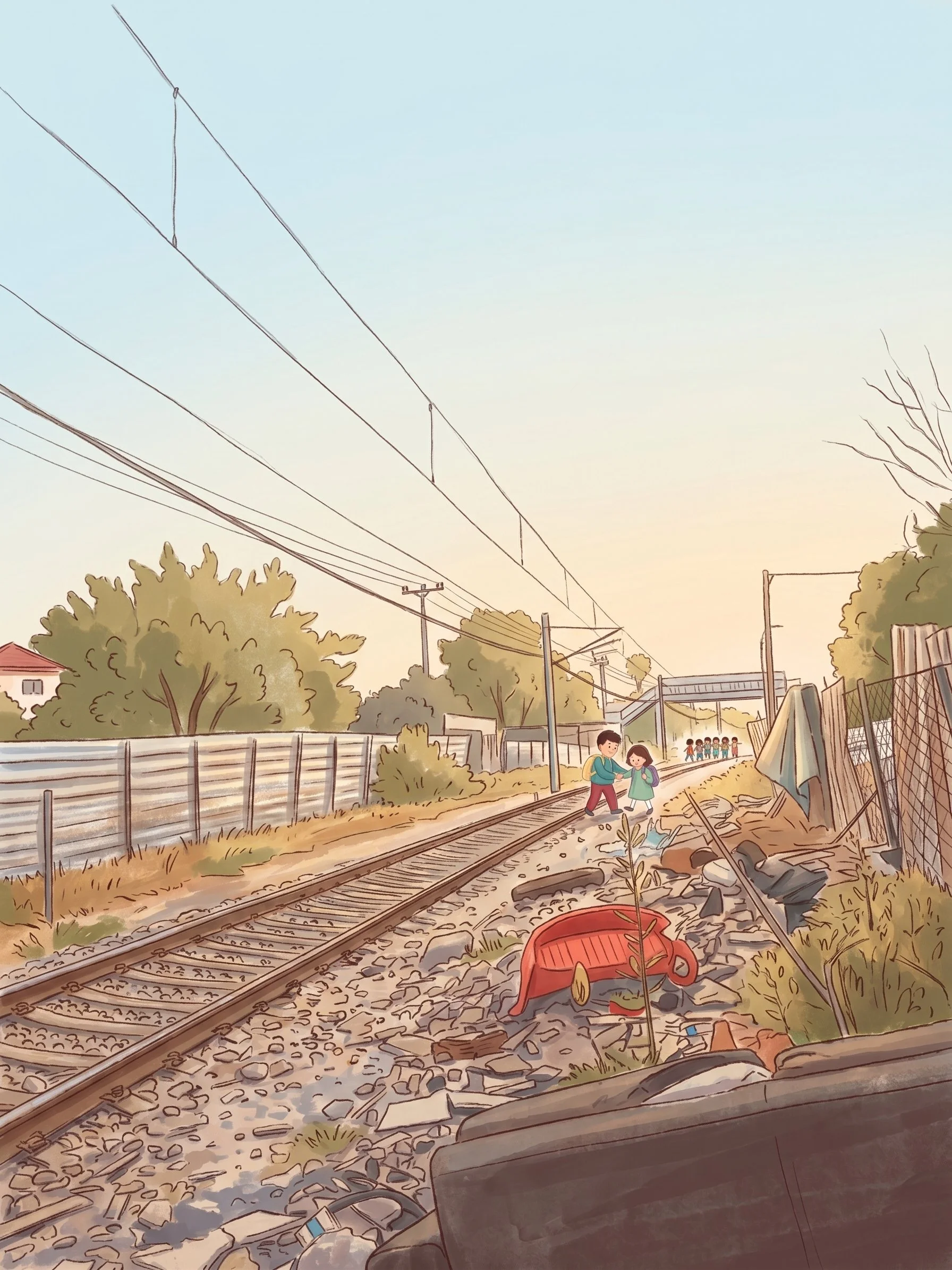
Similarly, in Lydd, Palestinian children have been forced to cross active railway tracks to reach their school. Authorities closed the only safe bridge connecting their neighbourhoods to school, without providing an alternative route. These practices demonstrate how educational deprivation operates alongside broader efforts to undermine Palestinian rootedness and territorial continuity.
Finally, Palestinian children's right to education is further undermined through widespread detention practices; approximately 700 Palestinian children are jailed every year under the Israeli military occupation. While they are in prison, such children have very limited access to education, and what education they do have is frequently conducted in Hebrew. After release, these children face significant barriers to reintegrating into the education system. Carceral practices thus reinforce the disruption of education beyond the school walls, interrupting children's entire educational trajectories and damaging their social development.22
“Who controls the present controls the past”17
Beyond physical access and infrastructure, the struggle over education is a struggle for knowledge itself. Increasingly, UNRWA schools have faced political pressure from Israel and allied donor states, who seek to revise, remove or relativise content relevant to Palestinian history, identity, and resistance. They claim to be motivated by a search for “neutrality” and the goal of “anti-incitement.”15 UNRWA follows host-country curricula outside Palestine, and maintains its own review procedures of material. However, controversies over the UNRWA curriculum has to do with the desire to control Palestinians’ access to collective, documented historical memory.
From a decolonial perspective, controlling what can be taught is a way to control how a people understands their own past, present, and a means to suppress their political consciousness. This struggle over knowledge affects Palestinians living in all the territories occupied in 1948 and thereafter. The entire education system is subject to the controls of Israel and involves the structural marginalization of Palestinian identity and politics, and Palestinianness as a whole.
Inside the territories occupied in 1948, under the 1953 State Education Law, the Israeli Ministry of Education retains overall authority over curricula and educational objectives. Palestinian history, culture and national identity remain taboo topics, while Zionist narratives and Jewish history occupy a central position. This contributes to the alienation of Palestinian students within Israeli schools and universities from their own collective history and identity. Structural inequality is reinforced through disparities in educational funding: Palestinian students receive approximately 78–88% less funding per student, resulting in overcrowded classrooms, inadequate infrastructure and higher dropout rates.16
Another dimension of the struggle for education is the imposition of Israel’s ‘sanitised curriculum’ in Palestinian schools in Al-Quds (Jerusalem) and in the 1948 Palestinian lands. This curriculum replaces Palestinian references with broader “Arab” terminology.18 It also removes Palestinian symbols and historical narratives,19 while promoting Israeli national symbols.20 Certain forms of funding depend on schools adopting the Israeli matriculation system (Bagrut) rather than the Palestinian Tawjihi.21 Such interventions go beyond curricular adjustment, and represent a sustained effort to reshape Palestinian identity through regulation of historical knowledge.
Resisting Scholasticide
Efforts to resist scholasticide are not new. Throughout decades of occupation, whenever formal education has been restricted, censored or destroyed, Palestinians have continuously created alternative spaces of learning. Education has long been understood as being about the transmission of knowledge, and an essential component of this is about the national struggle for liberation.
The Popular University & Basel al-Araj: One of the most powerful examples of this is the Popular University, an informal educational initiative associated with Bab el-Wad (باب الواد) and the Suleiman Al-Halabi Circle. Conceived as a free, community-based alternative to formal academic institutions, the Popular University offers open political, historical, and decolonial education without grades, tuition fees, or institutional barriers. Its courses focus on subjects often marginalized within mainstream education, including Palestinian histories of resistance, settler colonialism, the political economy of exploitation, and global anti-colonial movements.
Among its most influential educators was Basel al-Araj, whose work adhered to the Freirian principles, embodying the conviction that knowledge itself can be a form of resistance. His course, “Palestinian Resistance Since the Inception of Settler Colonialism”, traced more than a century of Palestinian struggles, from the late Ottoman period through successive uprisings and Israel's military assaults on Gaza. For al-Araj, history was not to be passively remembered; it was a tool through which Palestinians could understand the structures that shaped their lives. Through education and knowledge of their past, Palestinians could recover traditions of resistance that would inform their present struggles. Part of the method of Bab el-Wad were historical walking tours, which sought a tangible way to reconnect knowledge production with a sense of situated history and goals of collective liberation.
Scholasticide is the coloniser’s attempt to break the relationship between knowledge, historical memory, and political agency. Its aim is to deny Palestinians the spaces in which they can study their own past, analyse their present and imagine more liberated futures, collectively and individually. Yet oppression can never completely extinguish the human capacity to learn, reflect, and act. Palestinians remind us of this resistance to extermination. Across Palestine, education will continue to escape the confines of walls and shackles. Parents become teachers. Displaced educators organise classes in tents and shelters. Libraries are rebuilt from books donated. Stories, songs, oral histories and poetry preserve collective memories, even when archives have been destroyed. Popular education transforms homes, community centres, public squares and camps of those displaced by bombs and genocide. Classrooms emerge continually, so that knowledge can continue to circulate despite the siege, the occupation, the genocide and resulting displacement.
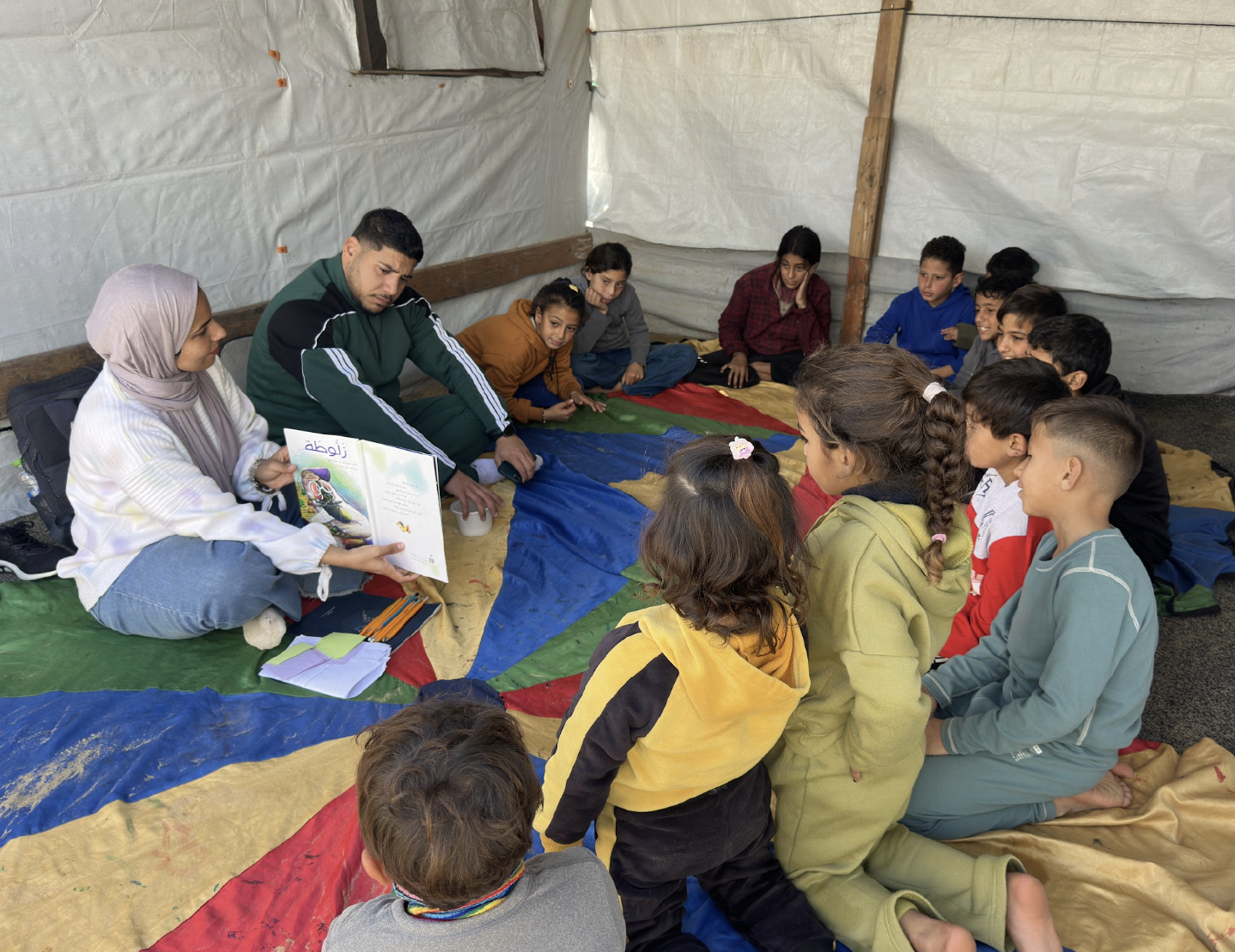
Education facilities have been reduced to rubble. Yet education survives, living within the minds and hearts of the Palestinian people. Freire insisted that liberation is not achieved by others speaking on behalf of the oppressed. The oppressed themselves need to reclaim their own voices. They must become the authors of their own history. Given this requirement, the sheer persistence of Palestinians in believing in education – whether in formal schools, community initiatives like the Popular University, or in everyday acts of teaching and learning – is critical for their future. Even under what seem truly impossible conditions – the striving for education remains an active affirmation of popular resilience. Remaining alert to opportunities for learning becomes an act of resistance against colonial erasure. Across Palestine there are a thousand efforts to continue to preserve historical memory, cultural identity, human dignity, and the possibility of Palestinian national liberation.
References & Documentation
- Gaza Academics and Administrators. Open Letter to the World, May 2024.
- UNRWA. Preliminary School Damage Assessment Report, June/July 2025.
- UN OHCHR. UN Experts Deeply Concerned Over Scholasticide in Gaza, April 2024.
- Palestinian Central Bureau of Statistics (PCBS). International Literacy Day Report, 2025.
- Freire, Paulo. The Pedagogy of the Oppressed (1968).
- Ibid.
- UNRWA Student Parliament. Address on Hope and Education, June 2023.
- Fanon, Frantz. The Wretched of the Earth (1961).
- Fanon, Frantz. A Dying Colonialism (1965).
- Jacir, Emily. Ex Libris. University of Wales Press, 2012.
- BADIL Resource Center. Right to Education Working Paper, 2021.
- Save the Children. DANGER IS OUR REALITY: The Impact of Conflict and Occupation on Education in the West Bank, 2020, p. 26.
- Save the Children. Ibid, p. 30.
- Official United Nations Systematic Education Incident Recording Start Date (2010).
- BADIL Resource Center. Press Release on Education & Identity, badil.org.
- Stop the Wall Campaign. Right to Education Documentation.
- Orwell, George. 1984 (1949).
- Tamimi, Tamara. Israeli Appropriation of Palestinian Cultural Heritage in Jerusalem, 2019.
- Al-Haq Organization. 70 Years On: Palestinians Retain Sovereignty Over East and West Jerusalem, 2018, p. 6.
- Palestinian Academic Society for the Study of International Affairs (PASSIA). Education in Jerusalem 2016-2019.
- Israeli Government. Five Year Plan for East Jerusalem (2018 & 2023).
- Save the Children. DANGER IS OUR REALITY Report, 2020, pp. 32–33.